
The 90-Day GRC Roadmap
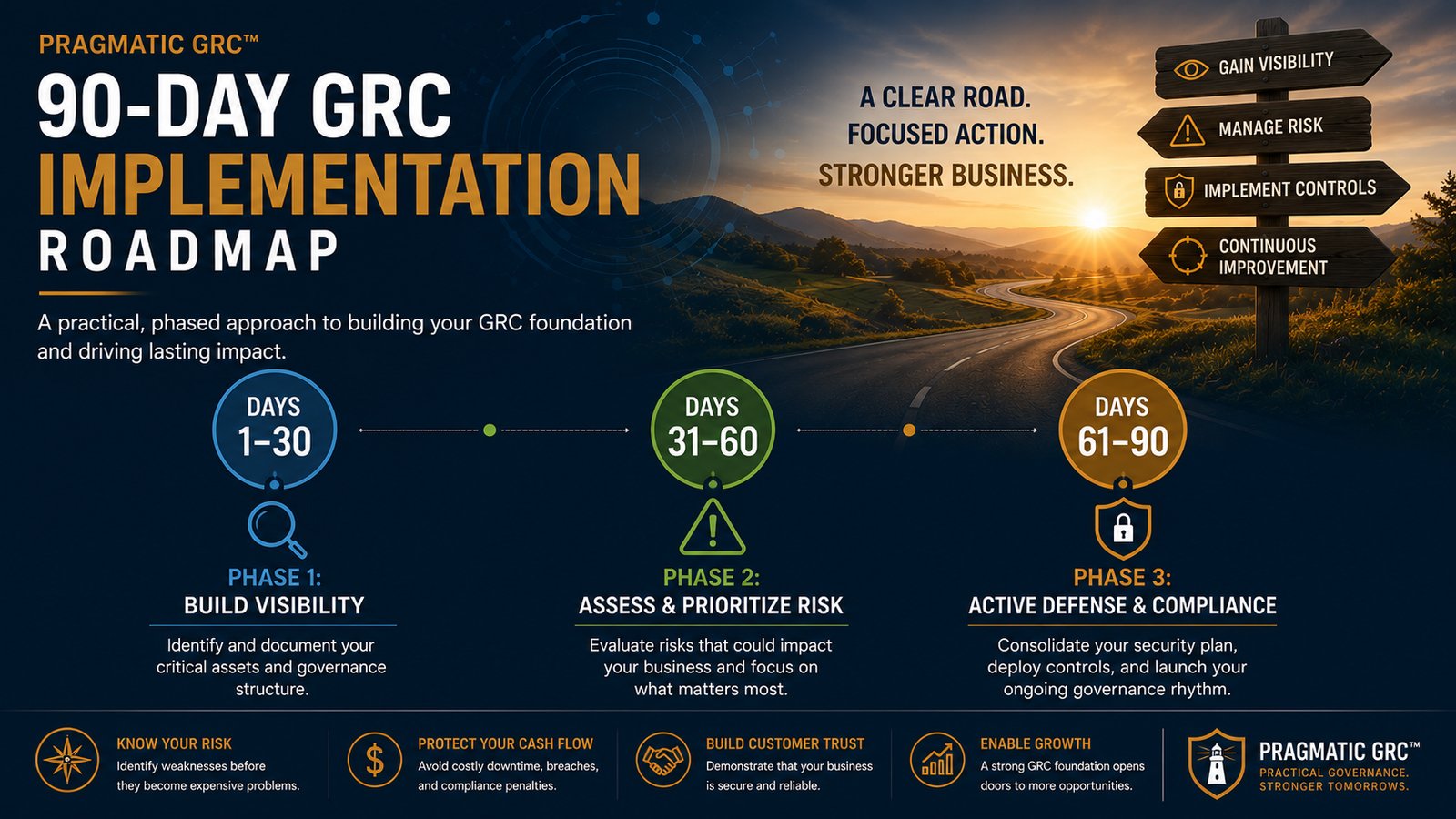
Why 90 days, and why this order
Most organizations struggle with governance not because the ideas are hard, but because they try to do everything at once.
The three phases at a glance
The three phases, step by step
Visibility, Structure & Steering
You cannot secure, govern, or pass an audit on assets you don’t know you own. This month is about radical transparency and clear accountability, nothing more ambitious than that yet.
Core infrastructure & vendor sweep
Catalog every cloud environment, key vendor, physical facility, and SaaS application that touches customer data into your Master Asset Register. The goal isn’t perfection — it’s an honest first pass at what actually exists.
F-001 Master Asset Register ↗Ownership & master key verification
Every asset gets a named internal owner. This is also where you confirm, explicitly, who holds the root administrative credentials — so an outside IT provider never fully owns your own keys.
C-006 Identity Offboarding Protocol ↗Codifying leadership roles
Draft who’s responsible for what. Define decision-making boundaries clearly enough that governance connects directly to business priorities, not a separate compliance exercise running alongside them.
F-004 Governance Roles ↗F-003 GRC Program Charter ↗Mapping Risk, Prioritizing Effort
With visibility in place, month two shifts from inventory to strategy — scoring hazards objectively so limited time and budget go where they matter most.
Hazard extraction
Populate the first pass of your Enterprise Risk Register: business uncertainties, single points of failure, process bottlenecks, and vendor or supply chain exposure.
R-003 Enterprise Risk Register ↗Technology & threat quantification
Evaluate the direct commercial threats facing your systems — data loss scenarios, downtime cost, and live exposure surfaces — in terms leadership can actually act on.
Cost of Inaction Calculator ↗R-004 Vendor Risk Assessment ↗Standardizing the evaluation cadence
Formalize how your team evaluates, prioritizes, and treats risk going forward, so it becomes a repeatable habit in regular meetings rather than something only done in a crisis.
R-005 Risk Treatment Plan ↗G-002 Monthly GRC Heartbeat ↗Active Defense & Keeping Promises
The final 30 days turn your governance and risk work into a continuous, self-sustaining routine — one that satisfies customers, insurers, and regulators alike.
Consolidating your security perimeter
Complete your Unified System Security Plan — access boundaries, identity policies, security controls, and patch procedures, all in one authoritative document.
F-002 Unified System Security Plan ↗Deploying daily operational practices
Put the plan into motion: MFA baselines, patching routines, backup verification, and an incident response process your team actually knows how to trigger.
P-Bundle Minimum Viable Policies ↗C-001 Incident Response Playbook ↗Closing the compliance loop
Map your contractual, customer, and regulatory obligations directly to the documents and controls you’ve already built — so compliance becomes something you can demonstrate continuously, not reconstruct once a year under deadline.
F-002 control mapping ↗Where most timelines actually go wrong
Ninety days is realistic, but only if you avoid a few predictable traps.
Adjust the timeline for your team
How many people can work on this?
Ready to put this into practice?
This page covers the shape of the roadmap. The book walks through each phase in full — the reasoning behind the sequencing, real case studies of what happens when organizations skip a step, and the templates, prompts and checklists that accelerate each one.
Prefer to talk it through? Talk to an advisor → · Browse the Resource Library →