
The Methodology
The Pragmatic GRC Methodology™
Simple. Practical. Sustainable.
A proven framework built around three living documents, four implementation guides, a monthly governance rhythm, and a 90-day roadmap.
Watch · 1 minute
The complete system in one minute
How change, the Three Living Documents, the Four Implementation Guides and the Monthly GRC Heartbeat fit together.
What Is GRC, Really?
Strip away the corporate jargon, and Governance, Risk, and Compliance is nothing more than navigating your business safely to its destination.
Governance
Your rudder and your map. It dictates who’s steering, how decisions get made, and the route you’ve agreed to take.
Risk Management
Keeping watch for icebergs. Knowing where the shallow waters are, and making sure you have enough life vests on board.
Compliance
Following the rules of the sea. Keeping the promises you’ve made to customers, partners, and regulators.
Practiced correctly, these three don’t slow your business down. They keep you from sinking.
The Pragmatic GRC Methodology™
Most GRC frameworks are written as if every business has a dedicated compliance department, an unlimited technology budget, and months to spend on paperwork. Small and medium-sized businesses don’t have any of that.
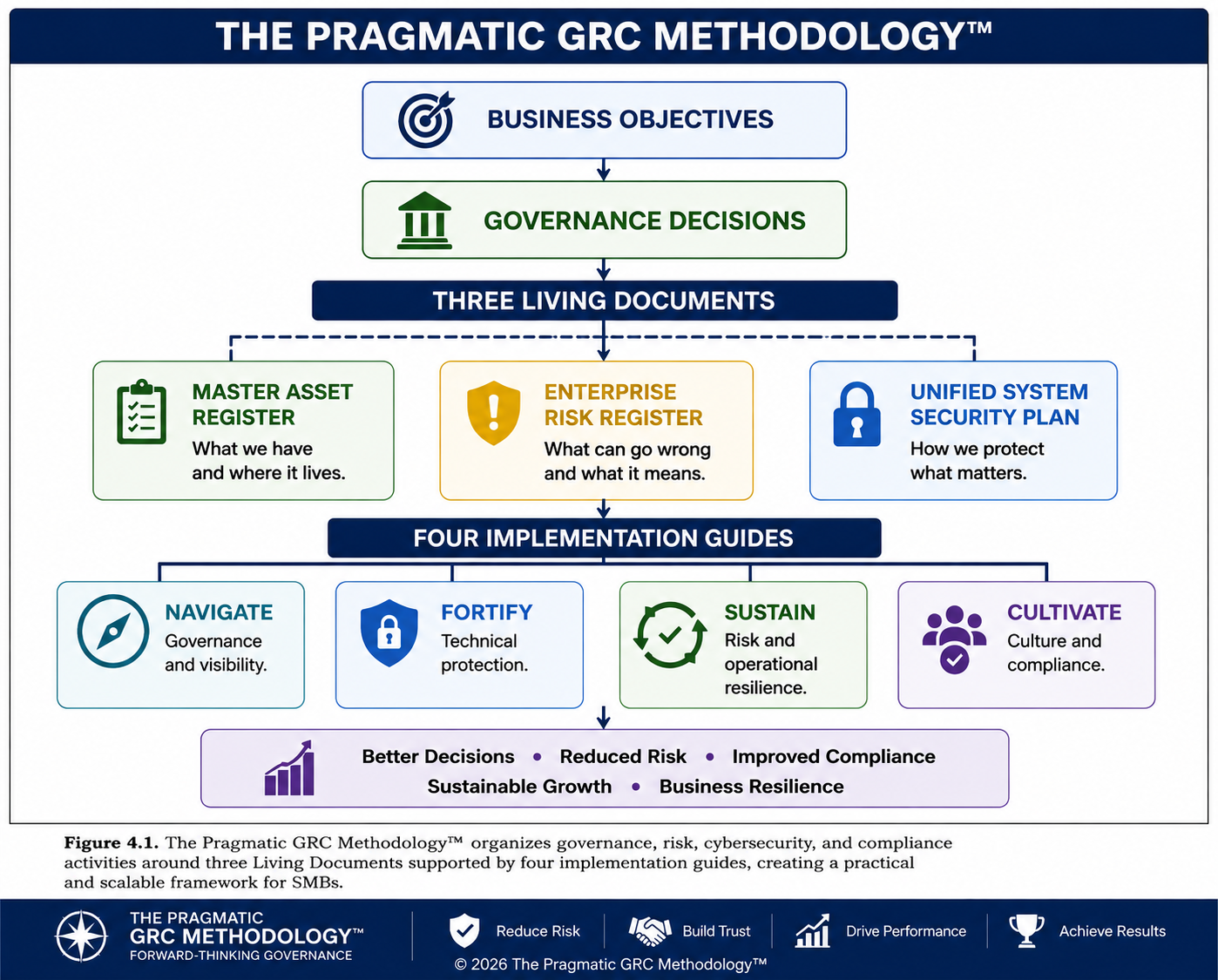
The Pragmatic GRC Methodology™ strips enterprise governance down to what actually matters — a lean, self-enforcing system built around three core documents, four recurring habits, and a single monthly check-in. Nothing here requires a compliance officer. It requires the people already running your business, each carrying a small, clearly defined piece of the responsibility.
Why This Works for Small Businesses
Traditional GRC assumes a dedicated team. The Pragmatic GRC Methodology™ assumes the opposite — that the people who already run your business can each carry a small, clearly defined piece of governance, without anyone becoming a full-time compliance officer. We call this Fractional Ownership, and it’s the reason this methodology fits a ten-person practice as naturally as it fits a growing company.
The goal was never to create more paperwork. It’s to help you make better decisions, protect what you’ve built, and keep moving at the speed your business actually needs.
The Three Living Documents
Everything in this methodology is built and maintained through three core records — documents that stay current, not binders that gather dust. You already saw the shape of it above; here’s what each one actually covers.
Master Asset Register
A complete inventory of what your business owns, depends on, and is exposed to — technology, vendors, data, and people.
Get the template →Enterprise Risk Register
A running list of what could go wrong, scored and prioritized so you know where to act first.
Get the template →Unified System Security Plan
Your central playbook for exactly how the business protects itself — access, backups, controls, and vendor security in one place.
Get the template →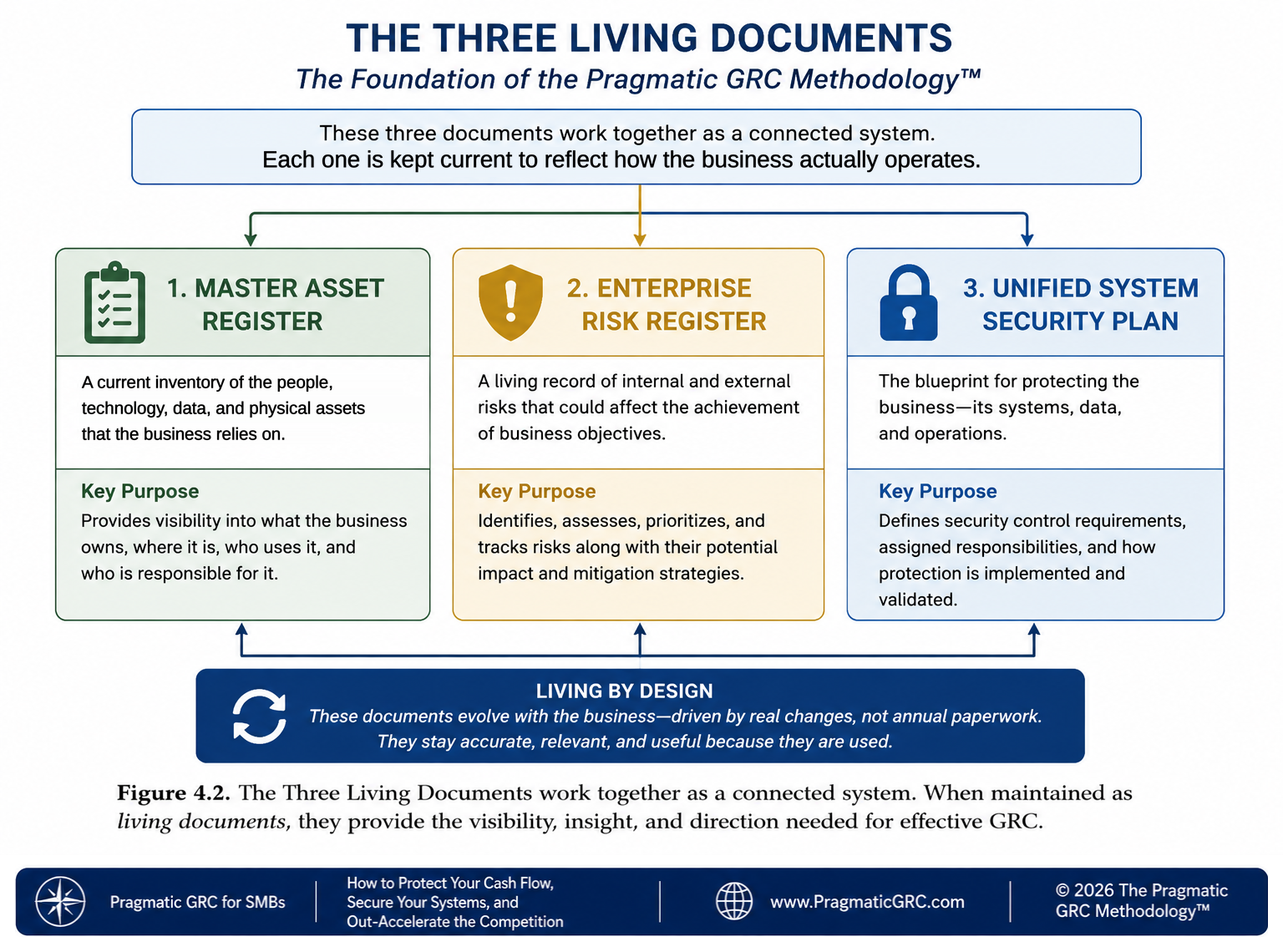
The Four Implementation Guides
The Living Documents describe your business. The Four Implementation Guides turn that description into daily habits.
Explore the Four Implementation Guides →
Navigate
Establish and maintain operational visibility — knowing what your business actually uses.
Open the guide →Sustain
Manage risk treatment, backups, and incident response when something goes wrong.
Open the guide →Cultivate
Build the habits and training that turn your team into your strongest line of defense.
Open the guide →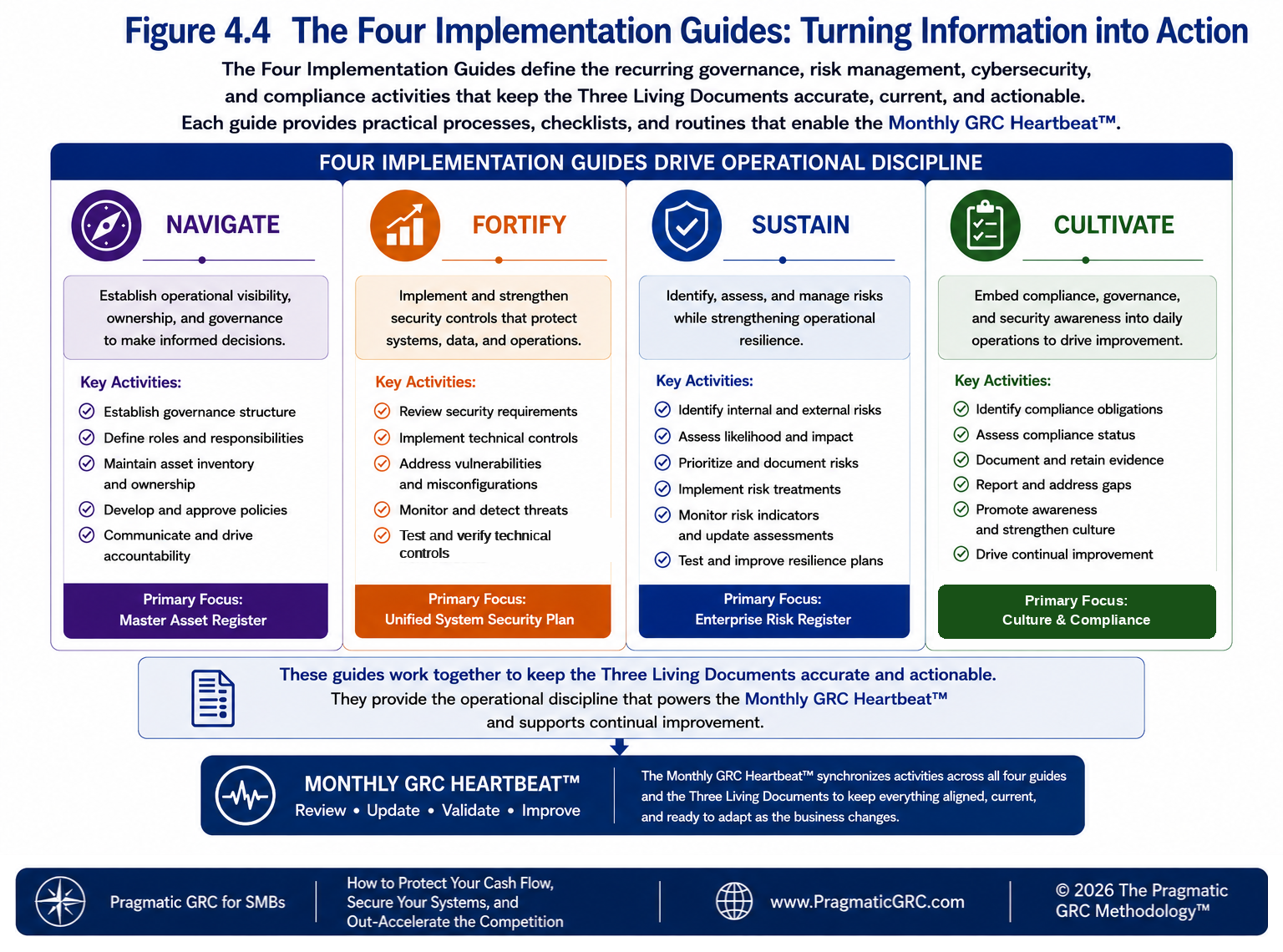
The Monthly GRC Heartbeat™
A methodology only works if it stays alive. This is the habit that keeps it that way.
One short meeting. Every month. No exceptions.
The Monthly GRC Heartbeat™ is a recurring check-in where your team reviews what’s changed, updates the Living Documents, and flags anything that needs attention — turning governance from an annual scramble into an ongoing business habit.
Get the Monthly GRC Heartbeat™ Checklist → Open the Heartbeat kit →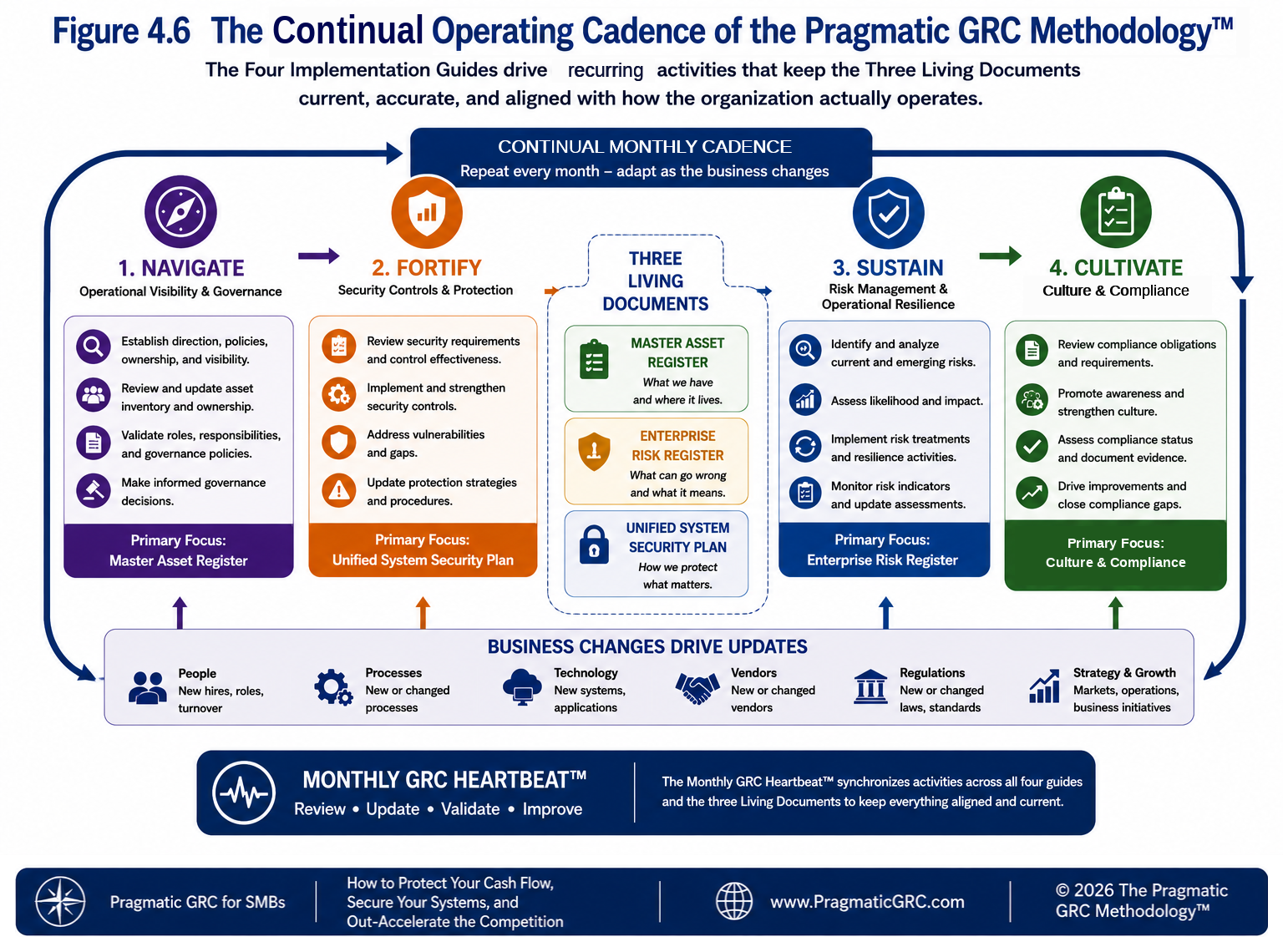
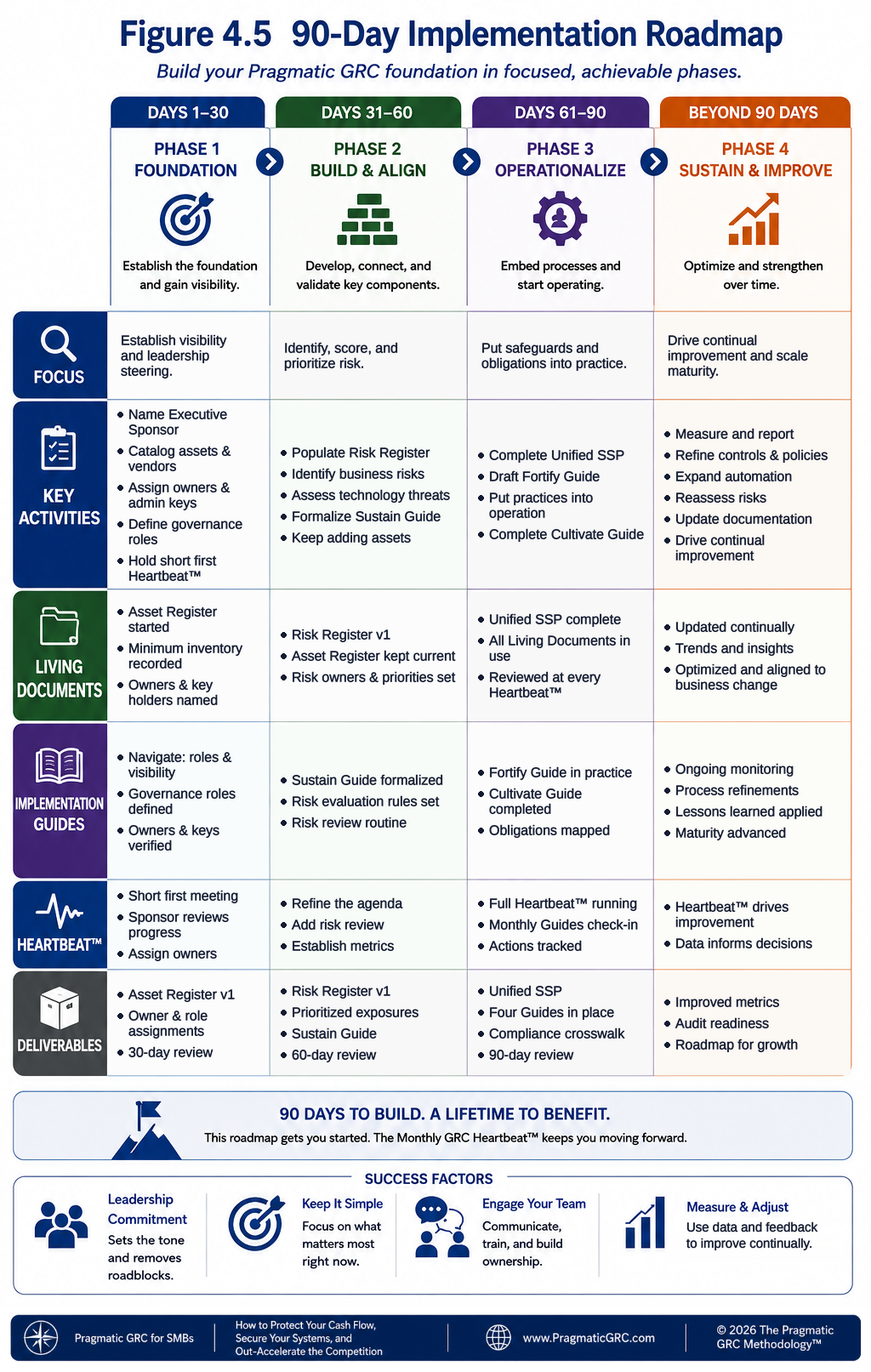
A 90-Day Path to Get There
You don’t need a strategic multi-year rollout. Most businesses can stand up the full methodology in about ninety days.
Know your assets — build visibility into what your business owns and depends on, assign an owner to each, and hold your first Monthly GRC Heartbeat™.
Understand your risk — identify, score, and prioritize what could actually hurt the business.
Protect and prove it — complete the Unified System Security Plan, put daily security practices in place, and map your compliance obligations.
The Twelve Principles Behind It All
Every idea in this book traces back to one of these twelve principles — a quick reference for why the methodology works the way it does.
Business First, Compliance Second
GRC exists to enable better business decisions, not to create paperwork.
Right-Size Everything
Every governance activity should match the size, complexity, and risk of the organization.
Simplicity Beats Bureaucracy
If it requires a specialist to understand, it’s too complicated for most SMBs.
Living Documents, Not Static Documents
Documentation should evolve with the business.
Governance Is a Daily Habit
Governance happens through consistent routines, not annual audits.
Visibility Before Security
You cannot protect assets you don’t know exist.
Risk Drives Priorities
Not every problem deserves equal attention.
Accountability Must Be Clear
Every asset, risk, and control should have an owner.
Measure What Matters
Use a small set of meaningful KPIs rather than complex maturity models.
Continual Improvement Is Non-Negotiable
Governance must evolve as the organization evolves.
AI Should Reduce Administrative Burden
Use AI to accelerate documentation while maintaining human accountability.
Governance Enables Velocity
Good governance removes friction by making decisions repeatable and predictable.
Where to Start
Pick the step that fits where you are today.
15 questions
Take the Readiness Assessment
See where your business stands today, scored across five domains.
Start the assessment →Free downloads
Get the Templates
Blank versions of the Living Documents, guides, and checklists, organized by chapter.
Browse the templates →Worked example
See It in Practice
Follow a fictional 10-person medical practice through its first months with the methodology.
See the example →